
Pierre Baldi
Department of Computer Science, University of California; Irvine, USA.
Charbel-Raphael Segerie
Centre pour la Sécurité de l’IA; Paris, France
As artificial intelligence (AI) systems become increasingly powerful, ensuring their
safety and alignment with human values is a critical challenge. In the same way that AI is
inspired by natural intelligence (NI), a first-principles framework for thinking about AI safety
can be obtained by examining the parallels between AI safety and NI safety. Human history
shows that NI is not safe, and multiple steps have been implemented by nature and by
humans to try to make NI safer. This perspective briefly outlines the multi-layered defenses
employed in NI safety, such as genetic safeguards, parental guidance, principles of conduct,
social fabric, transparency, legal frameworks, and enforcement, and their counterparts in AI
safety, including safer-by-design architectures, supervised training and reinforcement
learning, constitutional AI, agentic approaches, AI legal frameworks, and control
mechanisms. By drawing on these parallels, we can adapt proven strategies, anticipate
pitfalls, and frame open problems in AI safety, guiding our efforts to ensure AI remains
beneficial as it grows in power and sophistication.
The rapid advancement of AI has brought to the forefront the challenge of ensuring AI safety
–developing AI systems that are aligned with human values, behave reliably and robustly,
and avoid unintended harmful consequences, including the potential existential threat to
humanity. How can we think about AI safety in a principled systematic way? A valuable
source of insight that has been overlooked comes from the parallels between natural
intelligence (NI) safety and AI safety.
Indeed, today is not the first time that intelligence has posed existential risks to civilization.
Throughout history NI, in particularly human intelligence, has led to wars, genocides,
species extinction, and the invention of increasingly more sophisticated methods of torture
and weapons of mass destruction. Other common examples of unsafe NI range from
terrorists’ attacks to high school shootings. Given how dangerous our own intelligence can
be, it may seem miraculous that our species has survived. However, upon examination, it
becomes clear that evolution and humans have adopted a multi-layered approach to protect
our species from “rogue NI”. Building upon this observation, we propose a framework for
understanding and addressing the challenges of AI safety by drawing parallels between the
multi-layered defenses employed in NI safety and potential strategies for ensuring AI safety.
Through these parallels, we can systematically organize the landscape of AI safety research,
adapting proven strategies from NI safety, and develop a better overall approach to AI safety
that effectively mitigates potential risks, while also identifying new possibilities and
potential pitfalls.
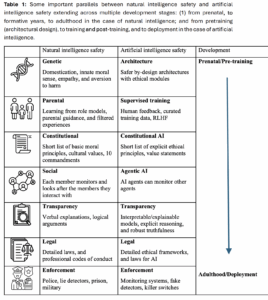
Table 1 schematically displays the multiple layers of NI safety, including Genetic, Parental,
Constitutional, Social, Legal, and Enforcement layers, and their parallels in AI safety. These
layers are organized roughly in time, along the developmental axis that goes from the
prenatal stage to the formative years, to mature adulthood in the NI case; and from the
design stage, to the training and post-training stages, and finally deployment in the AI case.
also primates, there seems to be an innate and primitive sense of ethic and empathy built in
our brains by evolution (1,2), reflected in Kant’s famous statement “Two things fill the mind
with ever new and increasing admiration and awe, the more often and steadily we reflect
upon them: the starry heavens above me and the moral law within me” (3). Just as feelings
of love and kinship promote prosocial behavior, the capacity for empathy and aversion to
harming others acts as a first line of defense against the misuse of our intelligence. How to
design safer AI architectures with ethical modules inductive biases that endow them with a
sense of empathy and morality, before, during, or after training, is an open problem and
active area of research. The partial success obtained by evolution in this area provides some
hope that at least a similar level of success ought to be achievable with artificial systems.
Parents and Other Role Models Examples and Guidance: The next layer of NI safety
comes from the examples set by parents and other role models during childhood. Through
observation and imitation, children learn to navigate the complexities of social interaction
and internalize norms of acceptable behavior. Children often also challenge these norms
and human societies have put in place various systems of reward and punishment to help
align children behaviors. In AI development, the parallel is the use of techniques like
supervised post-training and reinforcement learning from human feedback (RLHF) to align
AI systems with human preferences (4). By learning from human-provided examples and
rewards, AI can absorb our values and decision-making patterns. And just as parenting
requires careful attention to the lessons being imparted, it is essential to filter and curate the
data used for AI post training and alignment (5,6). While there are many technical challenges
in producing clean data suitable for AI alignment, it is nonetheless true that we have much
finer control over AI training data than we do with children.
Constitutional: Beyond relying on examples and individual reinforcement, NI safety also
relies on explicitly articulated principles and rules. There is a small number of good
principles that are presented to us explicitly during our formative years, again by parents, but
also by other role models, such as teachers in schools, or priests in churches. These are
very basic principles, such as those found in the 10 commandments of Christianity and
other faiths. The AI equivalent is the idea of “constitutional AI”, whereby a concise set of
principles is identified and used to constrain AI’s behavior, most often by being included as
a system prompt. For example, an AI system could use a version of Asimov’s “Three Laws of
Robotics” to prevent it from harming humans. Compared to RLHF, which requires extensive
human feedback that may be fragile, constitutional AI theoretically enables bootstrapping
ethical behavior from a single prompt. While this top-down approach to instilling values is
appealing in its simplicity, it faces challenges in terms of specifying principles that are both
comprehensive and unambiguous enough for machines to follow and as a result it is still
subject to jailbreaks.
Legal: However, constitutions and other small sets of broad rules of conduct are not
sufficient to rule human behavior in modern human societies. Far more complex,
comprehensive, and dynamic systems of rules must be created in the form of laws. These
laws can hierarchically control human behavior in an increasingly finer-grained fashion
across all areas of human activity, for instance from healthcare to transportation. While this
has not happened yet, it is conceivable that very detailed systems of laws may have to be
created, perhaps automatically, to govern the behavior of AI systems. Developing these legal
frameworks specifically for AI will require close collaboration between AI experts,
policymakers, and the public to ensure that innovation and safety go hand in hand. If a Large
Language Model (LLM) is asked a question about transportation, perhaps all the AI laws
regarding transportation issues should somehow be included in the prompt to contextualize
the response accordingly. How to build such laws and how to dynamically retrieve and bring
to bear large amounts of information on specific questions posed to large LLMs is an active
area of research with Retrieval Augmented Generation as a promising path (7).
Social: Another level of NI safety is provided by our very social fabric, basically each human
continually monitoring other humans they are interacting with and intervening accordingly.
This monitoring can already be enhanced or expanded using technology, such as
surveillance cameras. Likewise, AI agents and systems could monitor other AI agents or
systems on a large scale, and this monitoring could be enhanced and expanded by humans
further monitoring the AI. Embryonic versions of this are already operational in industry, for
instance in automated assembly lines with humans monitoring AI-monitored robotic
systems.
Transparency: Within the social level, transparency plays a particularly important role
which is worth highlighting separately. In human society, transparency is not just a value that
is taught, but it is also a fundamental principle that underpins trust and accountability. We
do not just teach children not to lie, we also expect politicians to disclose their taxes openly,
and we generally do not trust statements without justification. Similarly, in the context of AI
safety, we would like for example chatbots to justify their reasoning robustly, like humans
who can explain their decisions with clear arguments. However, ensuring transparency in AI
systems is not without challenges. Even when chatbots use chain-of-thought reasoning to
explain themselves, this reasoning can be completely wrong. AIs are subject to
hallucination, and what they say out loud often does not match the underlying reasoning
(11). Even worse, chatbots are capable of strategic manipulation or deception (12), further
complicating the issue of transparency. To address these challenges, researchers are
developing lie detectors for LLMs (13), but these are still fragile. Progress in AI interpretability
and explainability would be significant for AI safety, and AI interpretability may be more
tractable than NI interpretability, as we can perform much more controlled experiments with
artificial neural networks than with biological neural networks. While post-training
interpretability remains a difficult task, certain architectures and training approaches can
inherently result in more transparent systems. For instance, multimodal robotic systems
that are trained end-to-end to output movements directly can be less transparent than LLMs
that are trained to detail a mathematical argument step-by-step.
Enforcement: Finally, when all the previous levels fail, we use enforcement to corral
dangerous NI. When right and laws are transgressed, human societies resort to police,
incarceration, and even death penalty to protect themselves from NI, while armies and wars
are used at the supranational level. Many parallels can be made at this level. For instance,
polygraph lie detectors have AI fake detectors as their equivalent. The obvious parallel for
incarceration would be boxing and controlling any dangerous AI, which implicitly requires
continuously evaluating its ability to self-proliferate and self-exfiltrate from AI labs (8).
However, AI evaluation is hard, and upper bounding the capabilities of AI is an open problem:
we are constantly surprised by their emergent capabilities (9). Another parallel for the death
penalty would be the idea of having killer switches on all LLMs and in the future in all AIenabled robots (10). Yet another parallel, connected to the social level, is to explore whether
we can create something akin to AI autonomous police capable of apprehending malicious
AIs. This might include AI-powered anomaly detection to identify rogue systems, or
“tripwires” that automatically shut down AI that veers outside predefined parameters.
Discussion: The parallels between natural intelligence safety and artificial intelligence
safety offer a powerful framework for understanding, organizing, and addressing the
challenges of ensuring beneficial AI. By drawing on the hard-won lessons of evolution and
human history, we can identify and adapt strategies and anticipate potential pitfalls in our
efforts to create safe and aligned AI systems. In particular, any strategy so far used for NI but
not AI is worth exploring for possible adaptation to AI (e.g., rehabilitation centers). However,
it is worth noting that nor nature nor nurture were able to entirely solve the NI safety problem.
This could be a sign that the problem is too difficult and could not be solved entirely, or that
the problem should not be solved entirely. After all, humans ought to retain the ability to
fight, possibly violently, against adversaries, especially new adversaries that may emerge in
uncertain environments, including AI. In any case, evolution and culture seem to have
adopted a multi-level multi-faceted approach, one we are in the process of replicating for AI
safety.
Finally, it is important to acknowledge also the limitations of the NI/AI parallel. AI systems
are related to but different from brains, and their “cognition” may operate on different
principles than the brain, even if brains and neural networks partially converge in natural
language processing (14). These differences are obvious in the times scales of Table 1–
producing an aligned brain my take on the order of two decades, whereas producing an
aligned frontier AI model currently takes only the order of one year. The developmental time
scales are also warped: unlike AI, biology does not train a base model and then aligns it;
rather training and aligning appear to be much more interwoven throughout the stages of
human development. Moreover, AI systems can be duplicate rapidly and exactly in ways that
are not possible for brains. AI copies can share new information and collaborate or compete
in powerful ways. Together, these differences suggest that novel safety principles and
approaches specific to AI ought also to be researched, including more organic ways of
mixing training and alignment.
Despite these limitations, the NI-AI safety parallel offers insights and inspiration. It
challenges us to think beyond narrow technical solutions and consider the multi-layered,
societal-scale defenses needed to ensure AI remains beneficial as it grows in power and
sophistication. It also highlights the importance of interdisciplinary collaborations, as the
challenges of AI safety span fields from computer science to law, ethics, and governance.
References
1. Frans de Waal’s. Primates and Philosophers: How Morality Evolved. Princeton Science
Library, (2006).
2. Marc Hauser. Moral Minds: How Nature Designed Our Universal Sense of Right and Wrong.
Taylor & Francis, (2009).
3. Immanuel Kant. Critique of Practical Reason, (1788).
4. P. Christiano, et al., Deep reinforcement learning from human preferences. Advances
in neural information processing systems 30 (2017).
https://doi.org/10.48550/arXiv.1706.03741
5. Meta Fundamental AI Research Diplomacy Team (FAIR) et al., Human-level play in the
game of Diplomacy by combining language models with strategic reasoning. Science
378.6624 (2022), 1067-1074. https://doi.org/10.1126/science.ade9097
6. S. Casper, et al., Open problems and fundamental limitations of reinforcement
learning from human feedback. Transactions on Machine Learning Research (2023).
https://doi.org/10.48550/arXiv.2307.15217
7. P. Lewis, et al., Retrieval-augmented generation for knowledge-intensive nlp tasks.
Advances in Neural Information Processing Systems 33 (2020): 9459-9474.
https://doi.org/10.48550/arXiv.2005.11401
8. M. Kinniment, et al., Evaluating Language-Model Agents on Realistic Autonomous
Tasks. arXiv preprint. https://doi.org/10.48550/arXiv.2312.11671
9. W. Jason, et al., Chain-of-thought prompting elicits reasoning in large language
models. Advances in neural information processing systems 35, 24824-24837 (2022).
https://doi.org/10.48550/arXiv.2201.11903
10. A. Turner, et al., Optimal policies tend to seek power. Advances in Neural Information
Processing Systems 33 (2021). https://doi.org/10.48550/arXiv.1912.01683
11. M. Turpin, et al., Language models don’t always say what they think: unfaithful
explanations in chain-of-thought prompting. Advances in Neural Information Processing
Systems 36 (2024). https://doi.org/10.48550/arXiv.2305.04388
12. P. Park, et al., AI deception: A survey of examples, risks, and potential solutions. arXiv
preprint (2023). https://doi.org/10.48550/arXiv.2308.14752
13. L. Pacchiardi, et al., How to catch an ai liar: Lie detection in black-box LLMs by asking
unrelated questions. International Conference on Learning Representations 2024 (2024).
https://doi.org/10.48550/arXiv.2309.15840
14. C. Caucheteux, J. R. King, “Brains and algorithms partially converge in natural
language processing.” Communications biology 5.1 (2022). https://doi.org/10.1038/s42003-
022-03036-1